

The past may be a great teacher, but in 2017 history’s lessons resonate only to the most open-minded. As more and more minds close to each other, on the horizon a storm of growing, violent intolerance is blowing, threatening America’s most sacred values.
Last weekend brought casualties and death beginning when a man filled with hate verbally abused Muslim women on a train in Oregon. Men of conscience did the honorable thing, the American thing, and stood up to defend these women. Three men — Taliesin Myrddin Namkai-Meche, Rick Best, and Micah David-Cole Fletcher — were attacked. Namkai-Meche and Best (pictured) lost their lives.
Although it doesn’t fit neatly into our standard definition, this was terrorism. Every time we hear news from a mass shooting to someone driving a car into a crowd, our minds conjure up images of Islamic suspects before we know the facts.
We all do it. Whether it was a drunk driver in New Orleans or in Times Square running down people, we have a knee jerk assumption because it is easier to point the finger at the “other.”
But our history includes Timothy McVeigh and the Oklahoma City bombing. We’ve suffered multiple incidents when men ambushed and killed police officers. Serial bomber Eric Rudolph attacked the 1996 Summer Olympic Games in Atlanta which would have been far more devastating had the hero Richard Jewell not alerted hundreds of people. Those, too, are acts of terrorism.
Now, in the wake of every violent act, social media unleashes our emotions in volleys of misunderstanding and open resentment. Attacking those unlike ourselves in appearance, opinion or religion is not the path to our future.
The divisive forces of identity politics are not the way to “American Greatness” and are an affront to our history’s truth.
History’s truth is not an idealized version of our complicated story, but rather a past that is more inclusive than we realize. For example, Ron Chernow’s book on George Washington, “Washington: A Life,” upends the image of the sturdy mid-20s uniformed white Continental soldier.
French Officer Baron von Closen wrote, “It is incredible that soldiers composed of men of every age, even children of fifteen, whites and blacks, almost naked, unpaid and rather poorly fed, can march so well and withstand fire so steadfastly.”
The victory was won by sacrifice and hardship that united generations, race and class to overcome despair. Sadly, some who fought would have to wait over 80 more years for their liberty.
But Washington understood another underlying challenge for the new nation; a challenge that more than two centuries later has risen once again. “Religious controversies are always more productive of more acrimony and irreconcilable hatreds than those which spring from any other cause.”
In an increasingly fragmented world, the lessons we as a society teach our children will be what unites us. Rhetoric designed to splinter us and the “Us vs. Them” mentality must be a thing of the past.
The foundations of American greatness are in the people and not in a president. The foundations are in our homes, on our streets, in our community and in the handshakes we share standing on the common ground of our shared humanity. It is when people of conscience stand to oppose oppression and attacks on others.
I was fortunate to be born to visionary parents who lived a life of inclusion. They raised money to build an All-Faith Spiritual Center on Penn State’s campus. But it was in simple things too.
Just days after 9/11, while at dinner with my brother, they noticed some female Muslim students enter a restaurant wearing head scarves. Other people reacted with stares and mumbled comments. My father went over and spoke to them to make them feel welcome. It was a small gesture that spoke volumes in 2001.
But in 2017, how would others react to that gesture?
The men on that train in Oregon received their answer in an unwarranted fatal attack, one born of once-unspeakable intolerance that has become too common political discourse today.
On social media and in the political arena the rhetoric has heated up. The rational among us see it for the bluster that it is. But others internalize it, adopting it as a twisted American mantra. When faced with their moment, those words morph into violent action.
Leaders on all sides must understand that their words matter. Words can inspire positive activism. But careless language designed to spark outrage and attract attention may create violence.
The divisive gospel of identity politics threatens the ongoing journey of the United States to form “A More Perfect Union.” The journey’s path won’t be navigated solely by one party or group. America’s journey began with the idea that all men are created equal, that we are humanity’s best hope; the promised land of freedom for oppressed people.
At the dawn of our nation, George Washington wrote:
“We have abundant reason to rejoice that, in this land, the light of truth and reason has triumphed over the power of bigotry and superstition.”
In 2017 our challenge is to learn from our past, and ask if we are still awash in Washington’s light of truth and reason. We may not like what we see, but only together can we be the ones to banish the dark seeds of division and bigotry sown by hate-filled people on all sides.
More Columns
View all Columns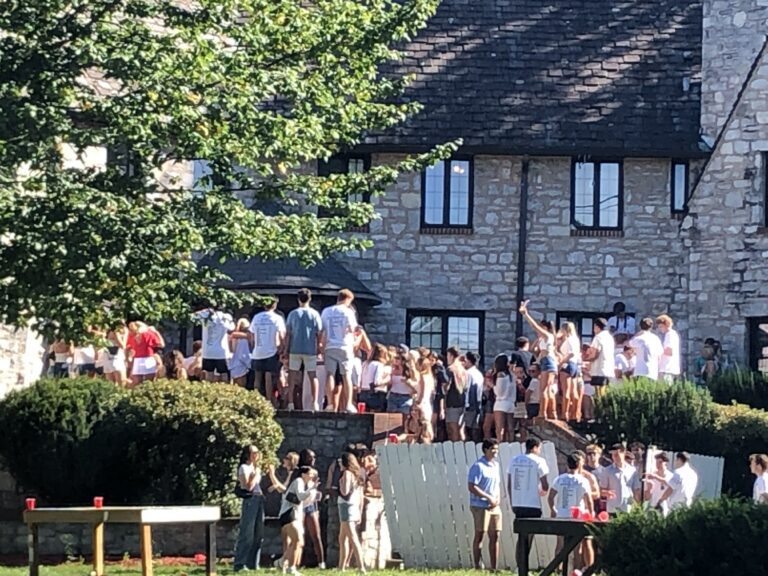
Greek Life at Penn State: Plus Ça Change
It was back to business as usual among the Woo people last weekend, which meant very loud outdoor parties, very many shirtless young males and very many young females wearing […]

It’s Time to Watch Penn State Linebacker Tony Rojas… Again
Watch Tony Rojas. He’ll be back at linebacker for Penn State on Saturday against Marshall, the culmination of a journey that seemingly took him everywhere, but ultimately brought him back […]

Hook: Weather Wonders and School Stress
Six days a week, my wife and I like to get out for a walk around the neighborhood. We skip Sunday – a day of rest and all – but […]


